



What is the maximum range of a walkie talkie?

Have you ever looked at a walkie talkie package and read “range up to 12 km,” only to find in real conditions that communication drops after a couple of blocks? It’s a common experience—and it’s not (only) the product’s fault. The range of a walkie talkie depends on several factors that technical specifications don’t always fully explain. In this guide, we’ll show you what really affects range, what to expect in real-world scenarios, and how to choose the best long-range professional two-way radios for your needs.
Declared range vs real range of a walkie talkie: what’s the difference?
The range shown on the packaging—whether 5, 10, or even 30 km—is always calculated under ideal conditions: open field, no obstacles, still air, and two perfectly aligned devices. In reality, these conditions almost never occur. In an urban environment, with reinforced concrete buildings that absorb and reflect radio waves, the range of a standard PMR446 walkie talkie can easily drop to 1–3 km. In open countryside or on a mountain ridge without obstacles, the same device can reach 5–6 km. This is not a defect: it depends on how radio signals propagate in the environment and how a walkie talkie works in terms of transmission and reception. Understanding this difference is the first step to making an informed choice—and avoiding surprises in real use. h2: What affects the range of a walkie talkie In some situations, the difference between a real range of 2 km and 10 km can determine the success of an excursion, an event, or a safety operation. That’s why it’s important to understand that not all two-way radios perform the same: the maximum range of a walkie talkie depends on device type, transmission power, and the environment of use.
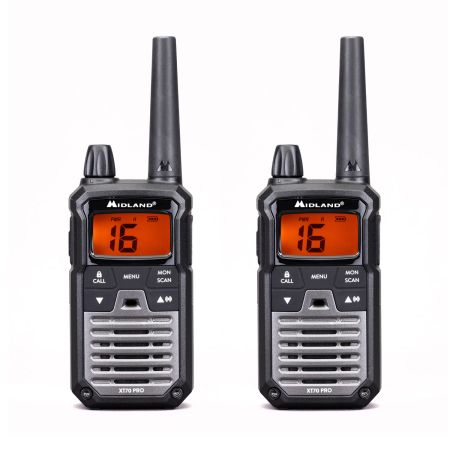
License-free PMR446 radios: Theoretical range up to 10–12 km, with an average real range of up to 1 km in the city and 2 to 5 km in open areas. Ideal for hiking, events, and recreational use.
Professional two-way radios: Average real range between 3 and 5 km in open spaces, thanks to higher power and dedicated frequencies. They are the right choice for construction sites, security, and logistics operating in complex local environments.
Repeater-based systems: Theoretical range up to 30–50 km. Actual distance depends on the installation height and can cover entire urban areas or large industrial complexes, making them ideal for large-scale communication.
In addition, several factors influence how many kilometers a two-way radio can cover, including:
Topography: Range is highest in flat open areas. In the mountains, a ridge can completely block the signal. In cities, every building is an obstacle.
Physical obstacles: Reinforced concrete buildings, metal structures, dense forests, and tunnels absorb or deflect radio waves, reducing coverage by up to 70–80%.
Antenna type: A long antenna provides better performance than short, compact ones, which can reduce range by up to 30%.
Analog vs digital technology: Digital radios maintain consistent audio quality until the edge of coverage, then drop abruptly. Analog radios degrade gradually: more noise is heard, but the signal can travel further.
Weather conditions: Heavy rain, dense fog, and strong winds can weaken the signal, although less than physical obstacles.
When long-range professional two-way radios are needed
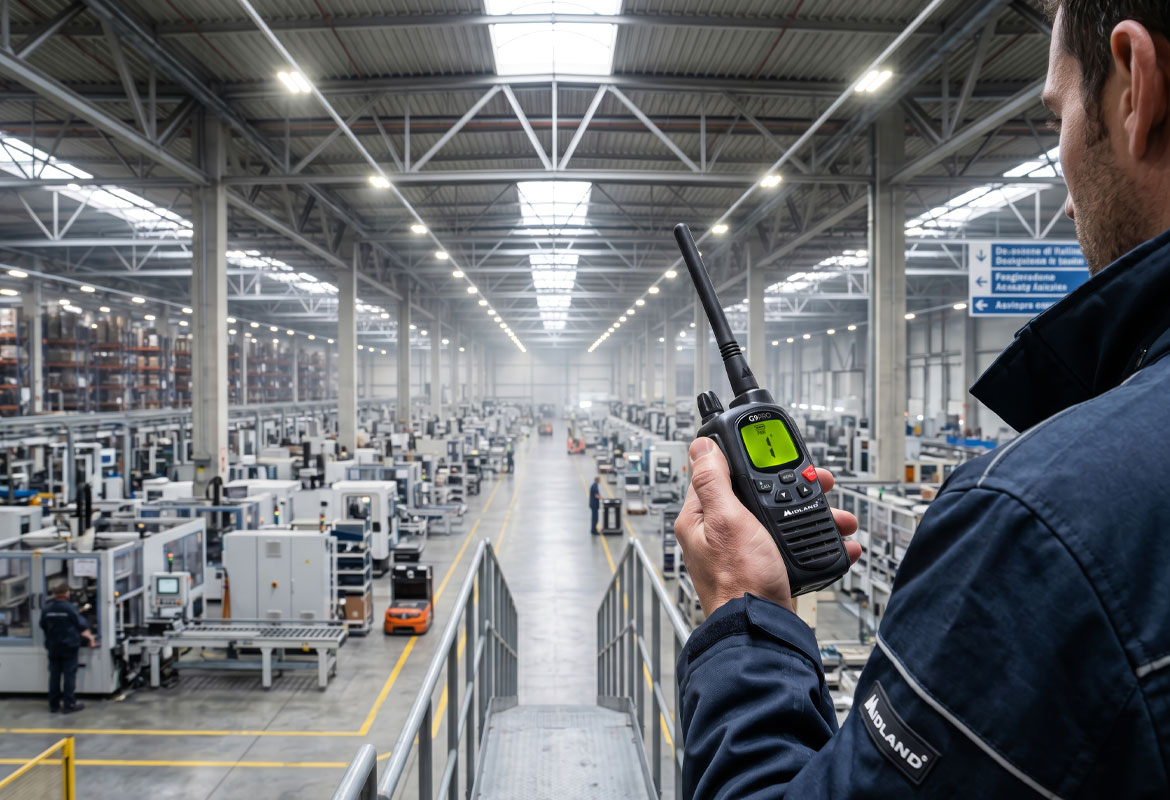
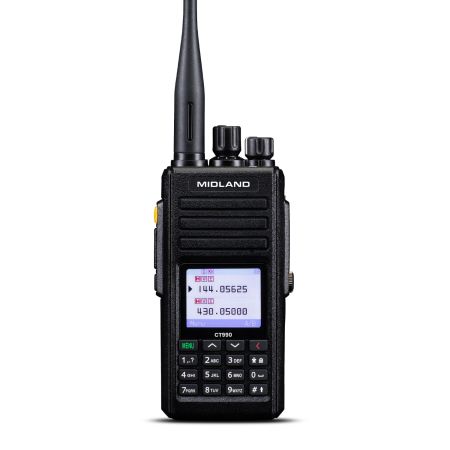
In some situations, a standard walkie talkie is enough to maintain communication within small groups or over short distances. However, when the area to cover increases, obstacles become more complex, or communication must remain stable at all times, long-range professional radios become essential. Large construction sites, industrial areas, security services, logistics operations, events, or outdoor activities in remote locations require devices designed to ensure greater reliability, better signal quality, and wider coverage than standard PMR446 walkie talkies. In these scenarios, clear and continuous communication is not just a convenience—it is essential for coordination and safety. The Midland range covers both needs: from compact and versatile PMR446 models designed for outdoor activities and team work, such as the XT70 PRO walkie talkie, to professional devices like the CT990 EBR amateur radio, built for those who need extended range and durability in extreme conditions.
How to choose the right walkie talkie
There is no universal answer, but asking the right questions helps clarify your needs:
Where will you use it? In the city, declared range is always overestimated. In open fields or at higher elevations, performance will be closer to technical specifications.
How many people need to communicate? For large teams, managing channels and sub-tones (CTCSS/DCS) is essential to avoid interference.
Do you need a license? PMR446 models are license-free across Europe. For longer distances and intensive professional use, licensed devices may be worth considering.
Is range or durability more important? For harsh environments (rain, dust, impacts), prioritize IP ratings and durability standards. For open areas, focus on transmission power.
The right range is the one that works in your specific environment. That’s why it’s important to understand which walkie talkie to choose based on your real usage needs. Whether you’re looking for long-range professional radios for work or simple devices for leisure, carefully evaluating real range, durability, battery life, and signal quality will help you communicate clearly and effectively—even in the most challenging conditions.
Don’t let distance isolate your communications