



Analog and digital walkie talkies: which one to choose

In the world of radiocommunications, the question "is it better analogue or digital?" is a great classic that has accompanied professionals and outdoor enthusiasts for years when deciding which walkie talkie to choose for their activities. Despite the advent of increasingly sophisticated technologies, traditional radio has by no means disappeared, but has evolved to offer superior performance in terms of clarity, range, and functionality. However, when faced with a technical sheet, it is not always easy to understand which technology is right for us. In this guide, we'll explore how analog and digital walkie talkies compare, breaking down the strengths of both systems to help you decide which tool to put in your gear.
Technical differences between analogue and digital walkie talkies
To understand which path to take, we must first understand how a walkie talkie works. The difference between analog and digital walkie talkies lies in the way the voice signal is transmitted over the air:
The analogue system: it is traditional technology. The voice is modulated directly on a continuous radio wave (usually in FM). It is an immediate, "pure" system and compatible with almost all devices of the same band (such as PMR446 frequencies). However, as you move away, the signal progressively degrades by introducing hiss and background noise.
The digital system (DMR): voice is converted into binary data (0 and 1) before being transmitted. This data packet is then decoded by the receiving radio. The main advantage? As long as there is coverage, the audio remains crystal clear. There is no classic analogue rustle: either you hear perfectly, or communication stops.
The advantages of the two technologies compared

Analyzing the nature of the signal is not enough, you also have to look at the practical benefits in the field. Here are the factors that weigh most heavily in the choice:
Audio quality and noise suppression: Digital wins over sound cleanliness. Thanks to error correction algorithms, digital radios are able to filter out ambient noise (such as wind or the roar of an engine) by returning only the voice. Analogue, on the other hand, although more prone to interference, allows experienced radiooperators to perceive a message even when the signal is very weak, "reading" between the rustles.
Battery life: In general, a digital device consumes less energy during transmission. Since the signal is not transmitted continuously but in short "packets" (TDMA technology), the battery tends to last up to 40% longer than an analog model of the same power.
Privacy and advanced features: If the security of conversations is a priority, digital is the obvious choice. It allows you to make individual calls, create closed groups, and encrypt communications. In analogue, on the other hand, anyone who tunes in to your channel can hear what you say, unless you use filter codes such as CTCSS/DCS tones, which however do not guarantee secrecy, but only isolation from noise.
Which one should I buy between analogue and digital walkie talkies?

The final choice depends solely on your use scenario. There is no "best" technology ever, but there is the most efficient one for your needs. If you're wondering which analog and digital walkie talkie to buy for your next purchase, here are some tips:
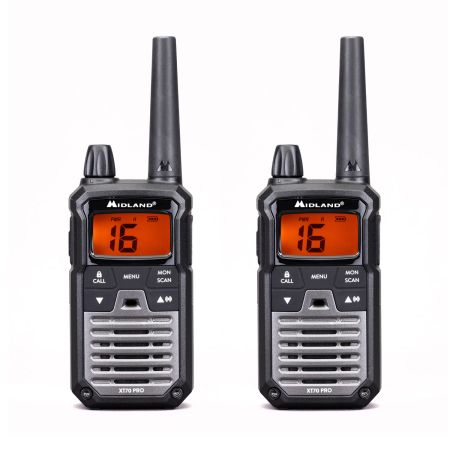
Choose analogue if: you practice outdoor sports, light hiking or you need simple-to-use radios for events and leisure. Midland analog models, such as the popular XT PRO series, are renowned for their reliability and ease of use.
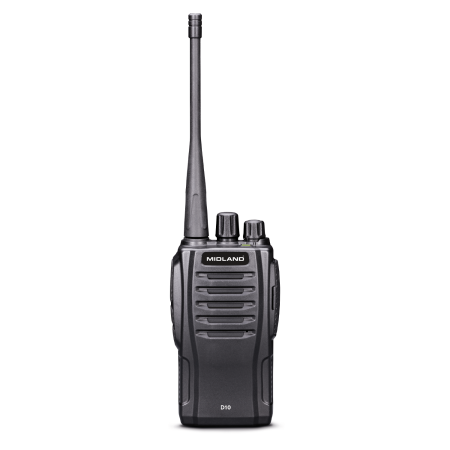
Choose digital if: you work in professional contexts, in security, logistics or in large industrial complexes. If you need private communications, text messaging and audio that is not afraid of construction site noise, digital is the right investment. A perfect example for your work tasks is the Midland D10 dmr transceiver, which combines the clarity of digital with the ruggedness required in the field.
Whether you choose the simplicity of analog or the precision of digital, the quality of the hardware is what really makes the difference between interrupted communication and perfect communication. Midland offers a complete range of devices designed to withstand shocks, bad weather and to always guarantee you the maximum possible range of action. Now that you know the difference between analog and digital walkie talkies, all you have to do is identify the model that will become your new adventure or work companion.
Ready to communicate without limits?