



Vehicle CB Antenna: How to Choose and Install the Best One

When it comes to CB communication, the radio alone isn’t enough — what really makes the difference in signal range and clarity is the antenna. It’s the key component that determines how far your voice can travel and how clearly it’s heard on the other end.
But how do you choose the right antenna for your camper, truck, or Off Road vehicle?
And how can you install it correctly to achieve the best performance?
In this guide, we’ll explain everything you need to know — from positioning and tuning to the most popular Midland models used by those who live the road every day.
What Makes a CB Antenna Truly Efficient

The quality of an antenna is mainly measured by a combination of technical and practical factors, including: position and ground plane, length and quality of the coil, mechanical strength and ease of tuning.
The ideal choice is to mount it as high as possible and in an area free of obstacles, centered on a continuous metal surface (such as the roof of an Off Road vehicle or a truck), because a good ground plane is essential to ensure that the signal propagates evenly and powerfully.
To this we add the length of the antenna, which directly affects range: a longer antenna, with a well-designed coil, offers a more stable and efficient transmission.
Finally, mechanical strength should not be underestimated: wind, vibrations and impacts are everyday occurrences for those who travel a lot, so a resistant model is an investment over time.
Length and Range: Finding the Right Balance
The rule of thumb is simple: the longer the antenna, the greater the signal range.
However, there are systems designed with great precision that manage to guarantee excellent performance even with shorter antennas, thanks to advanced technical solutions and component optimization.
How to Choose the Antenna for Your Vehicle?
Not all antennas fit your vehicle, because there are different needs that require specific technical features and certain installation methods.
For example, if you are looking for a CB antenna for an Off Road vehicle, the mounting choice will depend on the vehicle structure.
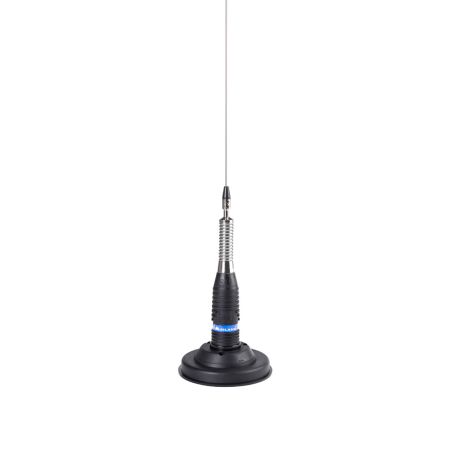
If the bodywork is steel, you can install it in the center of the roof using a magnetic base. Alternatively, it can be fixed on a PL bracket mounted on a solid part of the vehicle, such as the rear wheel holder, near the spare wheel.
For a truck, instead, it is better to use a bracket mounted on the side mirrors, with good ground connections to the cab or the chassis.
For a camper, which often has fiberglass bodywork, you need a specific antenna for non-metallic surfaces or with a “fake” ground plane simulated in the antenna structure, such as the Midland RV65.
Magnetic base or bracket? How to decide
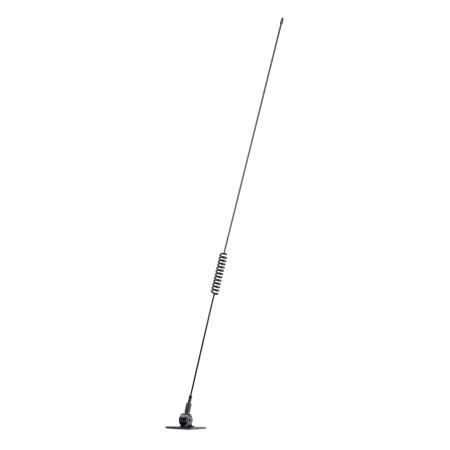
Magnetic antennas are the most practical: they are installed and removed in seconds, without drilling anything, perfect for those who want a temporary solution or for steel vehicles.
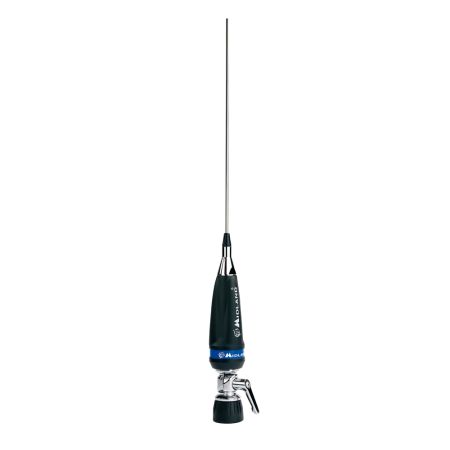
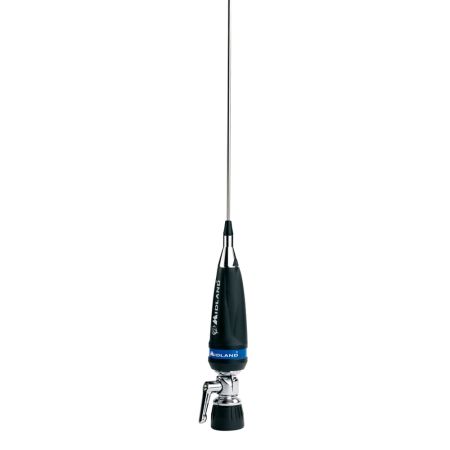
Bracket antennas, instead, require a fixed installation but offer superior performance.
They are more stable, last longer and guarantee greater efficiency.
Tuning: why it’s essential and how to do it
Tuning, often neglected by beginners, is essential to get the most out of the radio and to avoid damaging it.
It serves to ensure that the transmitted power is actually radiated by the antenna, thus obtaining a cleaner signal and optimal propagation.
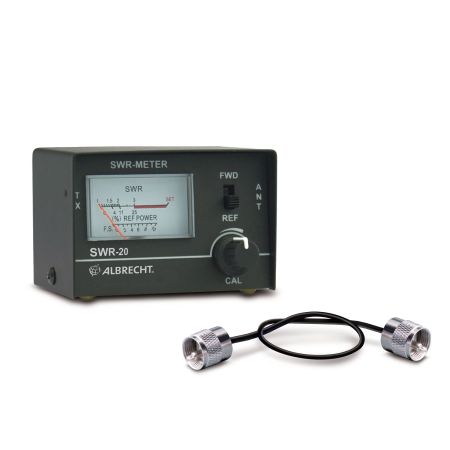
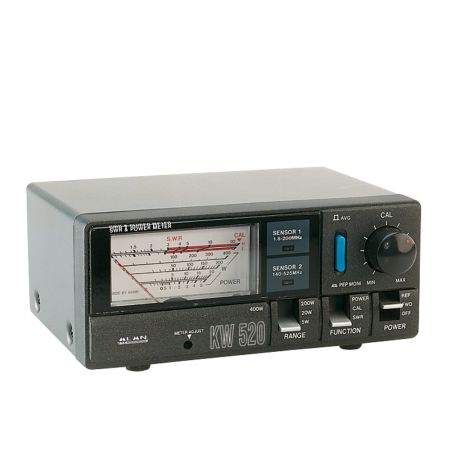
To do this, you only need an SWR meter, included in our SELF CALIBRATION KIT.
Take measurements on at least two distant channels (e.g. channel 1 and channel 40) to understand whether the antenna is too long or too short.
The ideal measurement is ≤ 1.5:1. If the value is between 1.5:1 and 2:1, adjust the whip length until it drops below 1.5:1.
Good tuning should always be done outdoors, away from walls or metal structures that could alter the measurement.
So, don’t forget to have among your accessories an SWR meter, which allows you to check in real time the correct tuning of the antenna: it’s small, inexpensive and makes a big difference.
Common mistakes and how to avoid them
Some typical errors compromise the performance of a CB system.
Here are the most frequent ones and how to avoid them:
Low or off-center mounting - always place the antenna as high and centered as possible
Insufficient RF ground - make sure you have good electrical contact between antenna and chassis, and if necessary add strong ground straps
Coiled or pinched coaxial cable - leave it free and well extended, with wide curves
Poor or oxidized connectors - use quality components and protect them with self-amalgamating tape or heat-shrink tubing
Tuning in a garage - always perform tuning outdoors and without metallic interference that could alter SWR measurement.
Midland antenna selection guide

Some antennas from the Midland range have become real icons for truck drivers and enthusiasts all over the world.
Here’s why, together with our technical team, we created a guide to choosing the best model according to your needs:
ML145 is the most widespread antenna ever, on the market for over 40 years. It can be mounted on the center of the roof or on a magnetic base with the dedicated kit, and is known for its reliability and ease of installation
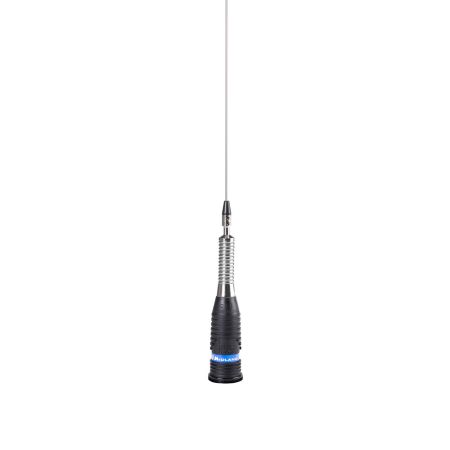
X-Turbo 60 e X-Turbo 80 are the choice for those looking for maximum performance in power, efficiency, and stability, even at high speeds. Perfect for fixed installations
Famiglia LUX are antennas for those who want to stand out. During transmission, they light up, making your communication unique, also visually
RV65 is specifically designed for campers and vehicles without a metallic ground plane. It installs easily and ensures excellent performance even on fiberglass surfaces.
All Midland antennas are Made in Italy and built with top-quality materials to offer reliability, durability, and superior performance in all conditions.
Choosing and installing the right CB antenna is not only a technical matter: it’s the way to ensure always clear, safe, and high-performance communication, in every situation.
Whether you drive a truck, a camper or an Off Road vehicle, a good antenna makes the difference between a weak signal and a stable, professional connection.
With Midland you can count on reliable and easy-to-install antennas, designed for those who live on the road every day and know that in communication, clarity is everything.