






Throat Mic for Airsoft: What It Is and What It Is Used for in Tactical Communication

In the world of airsoft, especially during long-duration Mil-Sim (Military Simulation) events, communication is the most powerful weapon a team can have. However, coordinating under enemy fire, in strong winds, or during a silent stakeout can be difficult with a traditional microphone.
This is where a piece of equipment derived directly from special forces gear comes into play: the throat mic. In this guide, we will explore in detail what an airsoft throat mic is, how it works, and why it can make the difference between victory and a return to "base camp".
How Does a Throat Mic for Airsoft Work?
To understand what an airsoft throat mic is, we need to move beyond the traditional concept of a microphone that captures sound waves traveling through the air. A throat mic is a transducer, meaning a device that converts one form of energy or physical quantity into another. It is worn in direct contact with the neck, typically secured by an adjustable strap.
Unlike standard microphones, this device captures the vibrations produced by the vocal cords through the skin of the neck (the larynx). These vibrations are then converted into electrical signals and transmitted to the radio. Because it does not rely on airborne sound, a throat mic eliminates almost all environmental noise, delivering clear voice transmission even in extreme conditions.
Military Throat Mics: From Special Operations to the Airsoft Field
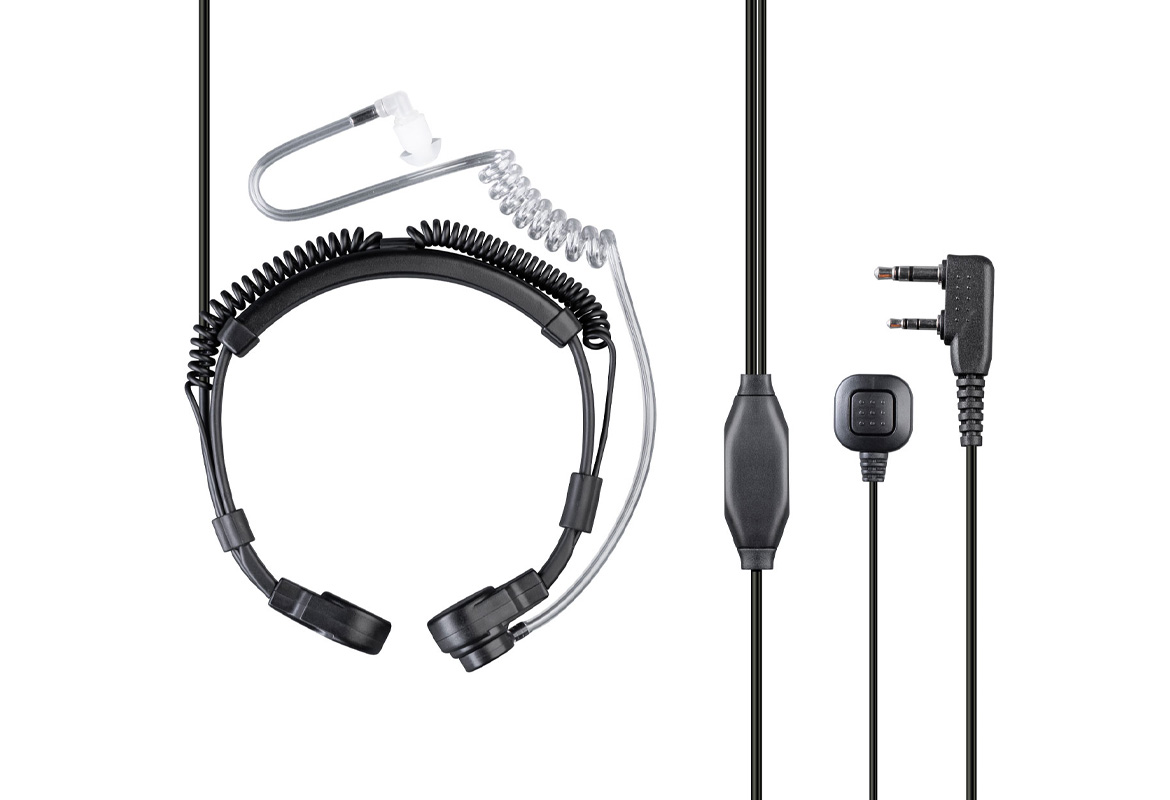
The military throat mic was developed to meet the communication needs of operational units such as tank crews and pilots, who work in environments with extremely high noise levels where a boom microphone would be ineffective. Using a professional-grade throat mic for airsoft brings that same reliability to the playing field.
These devices are designed to be rugged, sweat-resistant, and impact-resistant, ensuring communication remains uninterrupted when it matters most. In addition, their tactical appearance is a significant bonus for players who pay close attention to every detail of their loadout.
Why Use a Throat Mic During Airsoft Games?
If you are wondering what a throat mic is used for during gameplay, the main benefits are threefold:
Stealth Communication (Whispering): In airsoft, silence is crucial. With a traditional microphone, you generally need to speak at a normal volume to be heard clearly over the radio, potentially revealing your position. A throat mic allows you to communicate even while whispering, as the vibrations of your vocal cords are enough to transmit a clear message to your teammates.
Isolation from External Noise: Whether you are running, facing strong winds, or standing next to a teammate firing sustained bursts, the throat mic ignores most of these sounds. It transmits only your voice, eliminating the interference that often makes radio communications difficult to understand.
Compatibility with Helmets and Face Protection: Many communication devices interfere with protective masks or helmets. Since the throat mic is worn around the neck, it leaves the head free of obstructions, allowing comfortable use with virtually any type of facial protection.
How to Choose and Configure a Throat Mic
Switching from a traditional microphone to a vibration-based system requires a slight change in approach and proper setup. Buying the device is not enough; you must integrate it effectively into your gear to avoid poor communication quality or complete transmission failure. Here are some tips for choosing and properly configuring your airsoft throat mic:
Flexible Remote PTT and Tactical Placement: A quality tactical throat mic should allow you to respond instantly without taking your hands off your replica. Models such as the Midland MA 39 L and MA 39 LK feature a dedicated PTT (Push-To-Talk) button located at the end of a separate cable, designed for maximum mounting flexibility. Thanks to the adhesive and Velcro fastening system, you can position the PTT exactly where it is most convenient. This allows you to activate transmission with a quick, instinctive movement, even while wearing thick tactical gloves or aiming your replica.
Positioning and Fit: Unlike a boom microphone that simply needs to be positioned close to the mouth, a throat mic must maintain close contact with the skin on both sides of the larynx. If the device is too loose, an air gap will prevent the vibrations from being transmitted correctly, resulting in metallic or inaudible audio. On the other hand, if it is too tight, it can become uncomfortable after several hours of gameplay. The key is finding the right balance: the strap should be snug but flexible enough to allow free head movement while maintaining contact with the vocal cords. A useful tip is to perform a transmission test while turning your head to ensure the signal remains consistent in every position.
MA 39 L and MA 39 LK: Midland's Professional Solution

To meet the needs of the most demanding players, Midland offers two dedicated throat mics equipped with a high-sensitivity vibration sensor, a transparent acoustic tube earpiece, and reinforced cables:
Midland MA 39 L: The ideal version for users of radios equipped with a Midland 2-pin connector, such as the iconic Midland G7 Pro, G9 Pro, and the XT Pro series.
Midland MA 39 LK: Designed for radios featuring a Kenwood-style 2-pin connector, such as the Midland G10 Pro, D10, G11 Pro, and G13 Pro.
Both models provide maximum comfort thanks to their adjustable neck strap and soft silicone earpiece, making them ideal for extended use under a helmet or face mask. Choosing a reliable device means giving your team a clear tactical advantage: the ability to coordinate effectively while remaining virtually invisible and inaudible to the opposing team.