



Walkie talkies for children: why use them and which ones to choose
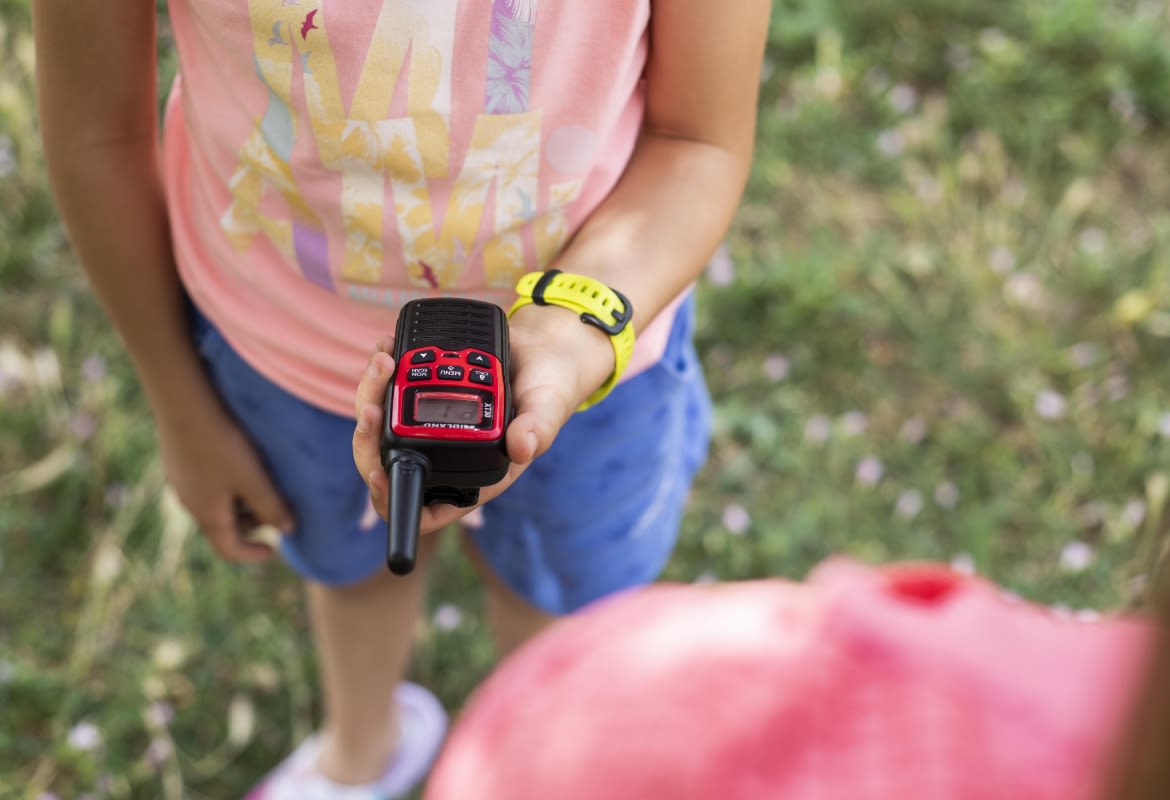
On a trip to the mountains, a day at the campsite, or a visit to a park, it may happen that children wander off to play or explore the surroundings. In these situations, having an easy way to communicate with them can be helpful, especially when the phone doesn't pick up.
Walkie talkies for children allow you to talk remotely without using a SIM or internet connection. They are easy to use and can accompany the little ones during outdoor activities, also offering an alternative to the smartphone.
But what features should be considered before buying? In this guide we will see how to choose a walkie talkie for children, what differences there are between toy models and PMR446 two-way radios and what solutions Midland offers.
Walkie talkies, toy or two-way radios for children?
Not all walkie talkies for children have the same features. On the market there are both toy models, designed mainly for fun, and PMR446 two-way radios that can also be used during excursions and family activities. Toy models are generally easy to use, but may have limited range and audio quality. Two-way radios for children based on the PMR446 standard, on the other hand, also offer useful features for communicating outdoors. Among the main features we find:
Range: It can reach several kilometers in favorable conditions, but decreases in the presence of buildings, vegetation and other obstacles.
Audio quality: allows you to communicate by voice without using the telephone network.
Convenience: Many models have compact dimensions, simple buttons and carrying clips.
Compatibility: PMR446 radios can communicate with each other using the same channel and compatible settings.
When and why are walkie talkies for children useful
Walkie talkies do not require an internet connection or phone coverage to communicate. For this reason, they can be used on different occasions, from family vacations to outdoor games.
Trekking and hiking in the mountains: On high-altitude trails, the cellular signal is often absent. Equipping each child with a radio attached to the shoulder strap of the backpack prevents those who walk at a faster pace from losing contact with the tail of the group.
Amusement parks, fairs and beaches: In very crowded places, a moment of distraction is enough to lose sight of the crowd. The walkie talkie allows an instant voice call, without having to unlock screens or hope that the phone rings.
Campsites and tourist villages: It is the classic context in which children experience their first outings alone with their peers. With a radio on their belt, they can go to the playground or sports field, always remaining within reach of their parents at dinner time.
Play and the development of imagination: In addition to safety, radios are an extraordinary play tool. They turn a walk into an "explorer's mission", stimulate the sense of direction and teach children to communicate concisely and clearly.
Are walkie talkies safe for children?
A legitimate question that many parents ask themselves concerns the security of communications: since these are open radio frequencies, is there a risk that strangers can talk to my children or disturb the line? The answer lies in the CTCSS (Continuous Tone-Coded Squelch System) sub-tones. The best radios allow you to set, in addition to the main channel (from 1 to 16 or from 1 to 8), a secondary numerical code. This filter ensures that the speaker of the child's radio opens only and exclusively when it receives a transmission sent with the exact same sub-tone set by the parents, muting all external conversations on the same frequency. Also, it's always a good rule of thumb to explain the basics of radio etiquette to children: never share full names, addresses, or personal details during broadcasts, remembering that radio is a shared tool for safety.
How to choose walkie talkies for children
Before buying, here are the key elements to check to ensure a practical, long-lasting and explorer-proof tool:
1. Size, weight and ergonomics
A walkie talkie that is too large can be uncomfortable to hold, especially for younger children. It is better to choose a compact and lightweight device, with easily accessible buttons. The presence of a belt clip can also be useful for carrying it during a walk or while playing.
2. Ease of use and key lock
Understanding how a walkie talkie works is quite simple: you press and hold the PTT (Push-to-Talk) button to talk and release it to listen to the response. For children, it is preferable to choose models with few, easily recognizable controls. The keypad lock, when present, also allows you to avoid accidental changes to the device settings.
3. Robustness and splash resistance
During outdoor activities, it can happen that the radio falls to the ground or is exposed to moisture and splashes of water. Before purchasing, check the materials of the body and whether it has an IP protection certification. Not all walkie talkies withstand rain and a water-repellent treatment does not necessarily equate to waterproofing.
4. VOX function
The VOX function allows you to activate the transmission automatically when you start talking, without having to hold down the PTT button. It is very useful for younger children or when they are busy cycling, and can temporarily turn the radio into a surveillance monitor if the child sleeps in a tent or in another room.
5. Power and batteries
Consider whether you prefer rechargeable batteries via micro-USB/USB-C cable, which are also very convenient in the car or with a power bank, or standard stylus/mini-stylus batteries (AAA), which allow you to start again instantly by replacing them on the spot if you are away from a power outlet.
The best walkie talkies for children: the Midland proposals
With over sixty years of experience in civil and professional radio communications, Midland has also applied its construction standards to models designed specifically for family use and for the youngest.
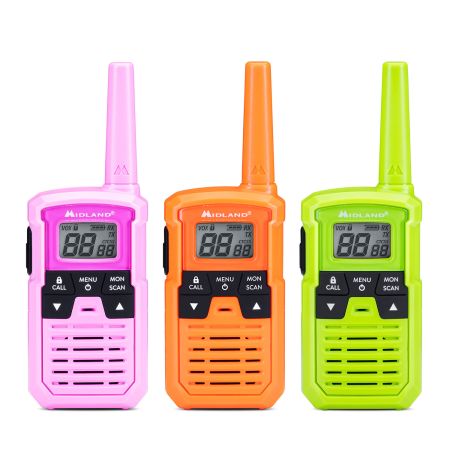
An example is the Midland XT10 Pro: born from the continuous dialogue with our community, it is one of the most popular solutions among the best walkie talkies for children and teenagers. Available in bright and high-visibility colors, it adds to the 4 km range and the VOX function a strengthened body with a special water-repellent treatment, designed to withstand dew, humidity and splashes of water during days outdoors.
Choosing good walkie talkies for children means investing in a reliable ally for the serenity of the whole family. Allowing your children to explore the world head-on, free from screen addiction and with the security of being able to reach mom and dad at any time, is the best way to educate them to conscious adventure.
Ready to experience the next outdoor trip in total serenity?