



How to Organize a Hiking Backpack

Anyone who spends time in the mountains knows that caution is never too much. Even the simplest hike, if approached too lightly, can lead to unexpected situations caused by weather changes, physical fatigue, or trails that are less marked than expected. In these situations, the difference between a minor inconvenience and a real emergency often depends on the quality of the equipment we choose to carry on our backs.
Many beginner hikers focus exclusively on technical clothing, underestimating the importance of a well-structured emergency kit. In reality, understanding exactly what to pack in a hiking backpack is an exercise in responsibility that every hiker should undertake before setting off. It’s not about overloading your backpack with unnecessary weight, but about selecting those lifesaving mountain essentials that ensure autonomy and safety when conditions become challenging.
How to Prepare a Hiking Backpack: 5 Essential Accessories

Beyond layered clothing and supplies of water and food, there is technical equipment that transforms simple gear into a true prevention system. Understanding how to pack a hiking backpack means balancing the load without giving up those tools capable of handling critical situations, from losing orientation to providing first aid.
In the following sections, we analyze the 5 accessories every hiker should include before lacing up their boots.
1. Navigation: What Should You Use to Avoid Getting Lost in the Mountains?
Losing orientation is the leading cause of mountain rescue interventions. We often rely entirely on smartphones, forgetting that batteries drain quickly and GPS signals can disappear in narrow valleys or dense forests.
So, how do you prepare a truly reliable hiking backpack? The golden rule is redundancy. A good navigation kit should always include a paper map of the area and a compass. These tools do not depend on batteries or satellites and, when used correctly, are the only devices that will never fail you. Of course, integrating a GPS device or mapping app is useful, but only as support rather than your sole resource. Knowing exactly where you are at all times is the first rule of safety, because awareness of your position is something that should never be missing from a hiking backpack.
2. Communication: How to Stay Connected Without a Network
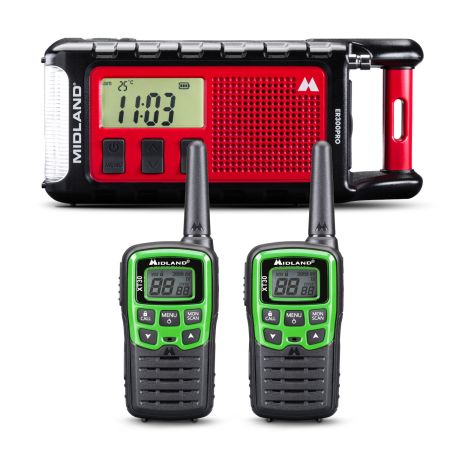
To stay connected even in the most remote areas, two-way radios have become one of the cornerstones of outdoor safety thanks to their short-range communication technology, which allows users to send and receive messages independently, without relying on external infrastructure or repeaters.
That’s why, if you are wondering how to pack a hiking backpack properly, communication should never be overlooked: a professional walkie-talkie makes coordination easier in case of separation or emergency, ensuring constant contact even over long distances. To fully take advantage of features such as emergency calls or rescue channels, it is important to understand what walkie-talkies are and how they work before tackling more demanding routes.
One of the most important aspects of collective mountain safety is compatibility with the Mountain Radio Network (Rete Radio Montana): a national project that uses a dedicated radio channel to connect hikers and rescue teams. Having a radio configured for this monitoring system significantly increases the chances of receiving timely assistance, making a two-way radio one of the most effective lifesaving mountain tools available.
3. Power Management and Lighting: Emergency Radios

Being stuck on a trail after sunset completely changes the perception of danger. A headlamp is a basic necessity, but what happens if the batteries die or your smartphone runs out of power and you cannot contact anyone?
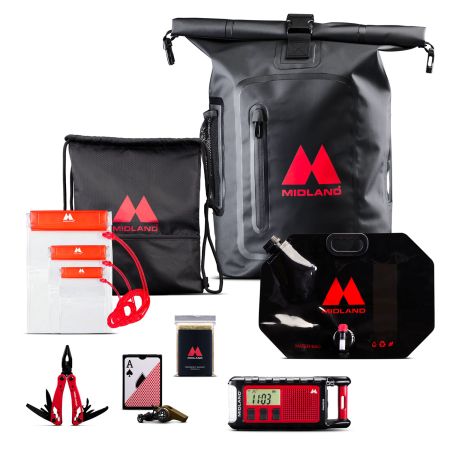
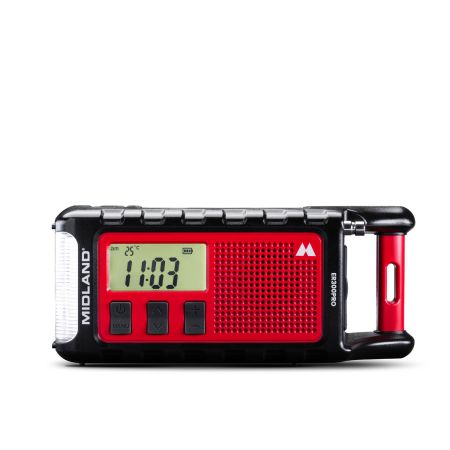
To meet this need, multifunctional devices such as Midland’s ER300 and XT30 emergency kits are designed to solve multiple problems at once. These tools integrate a powerful LED flashlight and a battery that can also function as a power bank. Their unique feature lies in their charging system: besides standard USB charging, they can also be powered by a dynamo crank or an integrated solar panel. Having a source of light and energy that does not rely on electrical outlets is crucial for signaling your position or recharging navigation devices during an unexpected stop.
These devices represent the core of Midland emergency systems and are now part of more advanced solutions designed to ensure autonomy in critical scenarios.
4. First Aid Kit: Managing Unexpected Situations in the Mountains
In the mountains, even a small incident such as a cut or a sprain requires immediate attention to avoid turning into a serious problem. When deciding what to pack in a hiking backpack, the keyword for your first aid kit should be simplicity without sacrificing completeness. A well-organized kit should include:
Wound care: disinfectant, sterile gauze, and plasters in different sizes, including blister-specific bandages.
Support and protection: elastic bandages, latex gloves, and useful tools for quick field interventions such as scissors or tweezers.
Personal medication: any medicines for daily use or specific personal needs.
However, the real lifesaver in the kit remains the emergency thermal blanket. It weighs only a few grams and takes up the space of a pack of tissues, yet it is essential for stabilizing the body temperature of an injured person, protecting them from extreme cold or excessive heat while waiting for rescue services.
5. Signaling and Survival: Being Found and Enduring
If the situation requires rescue intervention, being found quickly becomes the primary objective. A high-frequency whistle (audible over long distances and requiring less effort than shouting) is one of the most effective and lightweight lifesaving mountain tools you can carry. Alongside this, a small fire-starting kit and a signaling mirror complete your safety equipment. These compact items, together with an extra supply of water and high-calorie food, transform any backpack into a true survival system. Ultimately, understanding how to organize a hiking backpack properly is not a sign of fear, but a form of respect for an environment that is as fascinating as it is unpredictable. Selecting each of these items individually requires experience, time, and attention. That’s why Midland designed the ER Emergency Backpack, a complete emergency backpack that combines all the essential tools needed to manage the first 72 hours of an emergency, following European emergency preparedness guidelines.