



GPS collars for dogs: how they work and why to use them

For those who love experiencing nature with their dog, freedom of movement is essential—but it comes with an inevitable concern: the risk of losing them. Whether it’s a peaceful walk in the woods or an intense hunting activity, keeping visual control of the animal is not always possible. In recent years, technology has made significant progress, offering increasingly accurate and durable tracking solutions. However, navigating the different options can be complex: not all devices are the same, and performance varies greatly depending on the environment in which they are used. In this guide, we will explore in detail how GPS for dogs works, analyzing the differences between consumer and professional systems.
How GPS for dogs works
At the heart of every tracker is the GPS module (Global Positioning System). To understand how a GPS collar for dogs works, we need to imagine a process divided into two distinct technical phases: localization and communication of coordinates.
Localization (Satellite Reception): The collar worn by the dog acts as a receiver, capturing signals emitted by a constellation of satellites in orbit (GPS, but often also GLONASS or Galileo for greater accuracy). Once the signals are received, the device calculates its exact geographic position by triangulating data from multiple satellites to determine real-time coordinates. Communication (Transmission to the owner): Once the collar “knows” where the dog is, it must send this information to the owner. At this stage, GPS for dogs is divided into three different technological architectures, each with its own range and level of reliability.
What types of GPS trackers for dogs are available

Not all devices are the same: the choice does not depend only on budget but, above all, on the environment and the required level of reliability. A device that works perfectly in a city park may be completely useless in the middle of a forest. Understanding the differences between the available categories is the first step to avoiding mistakes and ensuring real safety for your dog. Here are the main technological categories currently available:
SIM-based systems (GSM/LTE): These models transmit the dog’s location using the cellular network, just like a smartphone. Data is sent to a server and displayed through a dedicated app. They are ideal for urban use or for dogs living in populated areas, as they offer theoretically unlimited range—provided there is network coverage. However, they have a structural limitation: if the dog enters a “dead zone” such as deep valleys, dense forests, or remote mountain areas, the device cannot update its position. This makes them less reliable exactly when you need them most, when the dog is lost in the wild.
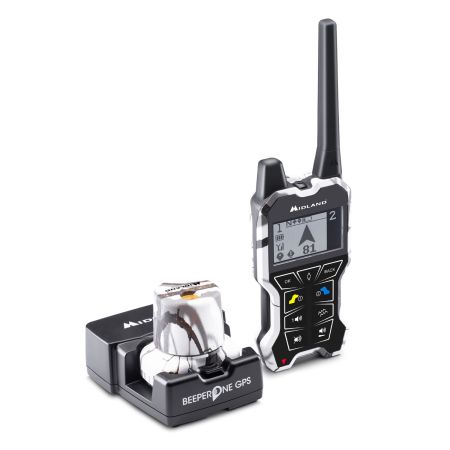
Radio wave and radio frequency systems (handheld devices): Mainly used by professionals and essential for hunting dog GPS trackers, these systems do not depend on mobile networks. The collar transmits coordinates directly to a handheld receiver via dedicated radio frequencies, such as the Beeper One GPS. This is the standard technology for anyone who needs total reliability in wild or rural environments, where mobile coverage is absent or unstable. They provide precise real-time tracking, are ideal for dogs that cover long distances, and allow users to view positions on preloaded topographic maps.
Proximity devices (Bluetooth): Often confused with GPS, these devices do not use satellite technology. It is important to clarify that common Bluetooth trackers only work at very short distances, connecting to nearby smartphones. They are suitable only for indoor use or small enclosed spaces, such as finding a pet hiding in a house or yard. In open environments or during outdoor activities, their usefulness is essentially zero: the lack of a built-in GPS receiver and the limited range make them unsuitable for tracking a moving or lost dog over large areas.
Why choose a GPS collar for dogs

The hunting world represents the most challenging environment for dog tracking. A GPS for hunting dogs must operate in extreme conditions, where terrain and vegetation constantly interfere with signals. Hunters know well that a pointing dog or tracking dog can cover kilometers in just a few minutes, often disappearing from sight behind ridges or into ravines. In these situations, a professional radio system offers advantages that a standard consumer tracker cannot guarantee:
Independence from the network: The system works everywhere, even in the most remote areas.
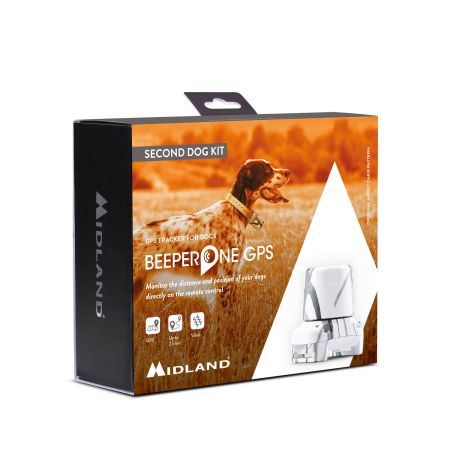
Group monitoring: Some hunting handhelds allow you to track multiple dogs at the same time, such as the Beeper One GPS kit, which can display the distance, direction, and status of each dog (whether it is moving or pointing).
Topographic maps: Unlike generic maps such as Google Maps, professional devices include detailed topographic mapping that shows slopes, waterways, and trails—essential elements for recovering the animal.
Specific functions: Many devices alert the owner via vibration or sound when the dog is on point or starts barking on game.
Understanding how GPS for dogs works means realizing that you are not buying a simple gadget, but a risk prevention tool. Losing a dog can have serious consequences not only for the animal but also for public safety.
For this reason, choosing a technology designed to operate even in remote areas without mobile coverage is essential to make every outing safer and more controlled.
Do not leave your four-legged companion’s safety to chance.