



Action cameras: how to choose the right one

There are moments when a smartphone or a traditional video camera inevitably shows its limits: a fast MTB descent, a day out on a boat, or an inspection in a dusty environment. In these scenarios, where vibrations are constant and exposure to the elements is extreme, the only device capable of delivering high-quality footage is an action camera.
Once reserved exclusively for extreme sports, these devices have now become indispensable companions for anyone who wants to document travels, passions or professional activities with complete freedom of movement. However, the wide range of models and technical specifications available can make it difficult to understand how to choose an action camera that truly meets your needs. To make the right investment, it is essential to look beyond design and analyze the technical parameters that ensure stability, battery life and real-world durability.
What are action cameras?
Often mistaken for standard digital video cameras or the latest-generation smartphones, action cameras are actually ultra-compact optical devices specifically designed for mobility. Enclosed in impact-resistant housings and often natively waterproof, they are built to operate where traditional technology would fail: in the dust of a motocross trail, the mud of a mountain bike ride, or the pressure of underwater environments.
Unlike a standard camera, an action cam integrates a fixed wide-angle (fisheye) lens, a sensor optimized to handle strong light contrasts, and dedicated software for electronic stabilization. This combination allows the device to record smooth footage even when subjected to heavy shocks, turning it into a tireless eye capable of capturing the user’s point of view (POV) completely independently. H2: What are action cameras used for? In a context where smartphones are becoming increasingly advanced, it is legitimate to ask what action cameras are actually used for. The answer lies in their very design: their primary purpose is to act as a subjective “eye” that follows the user everywhere, delivering stable footage in situations where the fragility of a traditional camera would prevent its use. Their compact, rugged and easily mountable structure allows for stable and immersive recordings even in extreme conditions, where a smartphone would be fragile, bulky or ineffective. Thanks to these features, their use goes far beyond simple entertainment and extends into several areas:
Outdoor and adrenaline sports: The go-to tool for cyclists, skiers and climbers who want to document their performance without bulk.
Underwater activities: Their waterproof construction allows users to explore underwater environments during snorkeling or professional diving, capturing the clarity of the underwater world.
Vlogging and travel: Extreme portability and the presence of dual displays in many modern models make it easier to tell travel stories, allowing users to frame themselves easily while walking or riding.
Safety and coordination: In some professional fields, action cameras are used to document work procedures or inspections in confined spaces.

How does an action camera work?
The operation of an action camera relies on technology designed to balance compact dimensions with high image quality. The heart of the system is not just the lens, but the image processor that handles data in real time. Among the technological pillars that enable its performance are:
Sensor and wide-angle lens: Most devices use a fixed-focus lens with a very wide field of view (FOV), allowing them to capture everything in front of the user without the need to adjust focus.
Electronic Image Stabilization (EIS): Unlike optical stabilization, electronic stabilization slightly crops the edges of the image and uses complex algorithms to compensate for camera movement, making the final video incredibly stable even during rough descents.
Frame rate and resolution: Smoothness is ensured by the frame rate (FPS). If you’re wondering which action camera to buy, always check the frames per second: for sports, a device capable of recording at 60 FPS or higher allows for high-quality slow-motion footage, capturing details that the human eye would otherwise miss at high speed.
How to choose an action camera
Once you understand how it works, knowing how to choose an action camera means evaluating the parameters that really matter in real-world use:
Video resolution: 4K is now the standard for sharp, detailed images, but you should also consider sensor performance in low-light conditions.
Advanced stabilization: Make sure the stabilization software is up to date to avoid the “seasick” effect in dynamic footage.
Native waterproofing: Check whether the camera is waterproof without a housing (often up to 10 meters) or if it requires an external case for deeper dives.
Battery life: Action cameras consume a lot of power due to high-resolution recording. Models with replaceable batteries are preferable to avoid interrupting recording sessions.
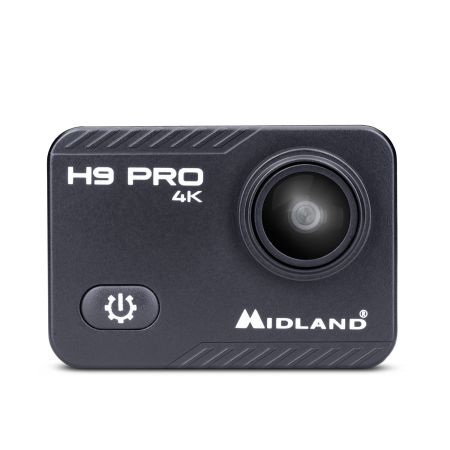
For example, a 4K action camera with advanced electronic stabilization and a replaceable battery, such as Midland H9 Pro, is particularly suitable for those who practice outdoor sports or travel frequently and need smooth footage while on the move. Beyond hardware, setup also plays an important role:
Mounts and accessories: Choosing the mounting point (head, chest or wrist) can completely change the narrative of a video.
Exposure settings: On very sunny days or snowy terrain, adjusting exposure helps prevent overexposed images.

Why choose an action camera?
After exploring the potential of these devices, it becomes clear that an action camera is the ideal ally for anyone looking for an indestructible digital memory of their adventures. Choosing this technology means worrying less about your equipment and focusing entirely on the action, confident that every moment will be captured with maximum color accuracy and stability. The true strength of high-quality hardware lies in its ability to act as a silent and tireless witness. Being able to rely on a device that can handle water, mud and impacts ensures continuous documentation in every season. Whether the goal is improving athletic technique or creating spectacular video content, a reliable action camera transforms adrenaline into sharp images and lasting memories.